
Brooches


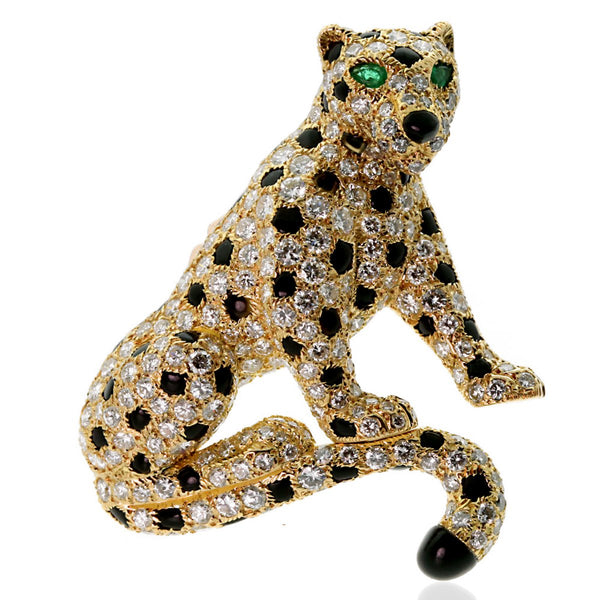

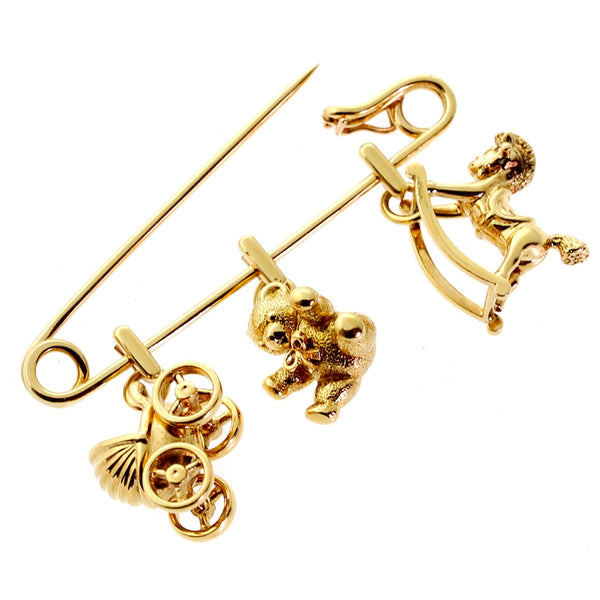
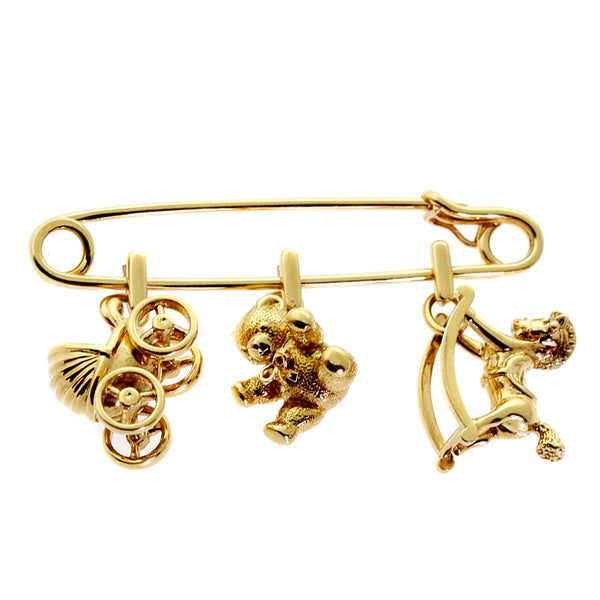

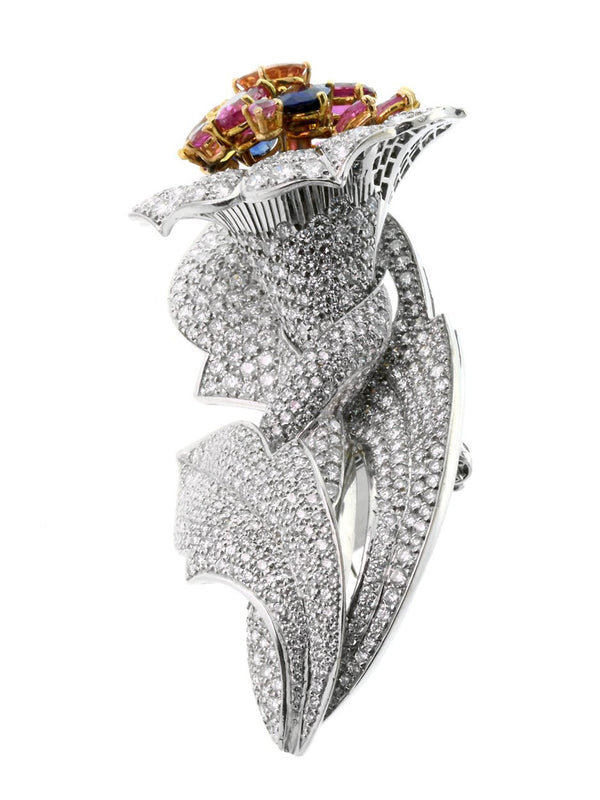
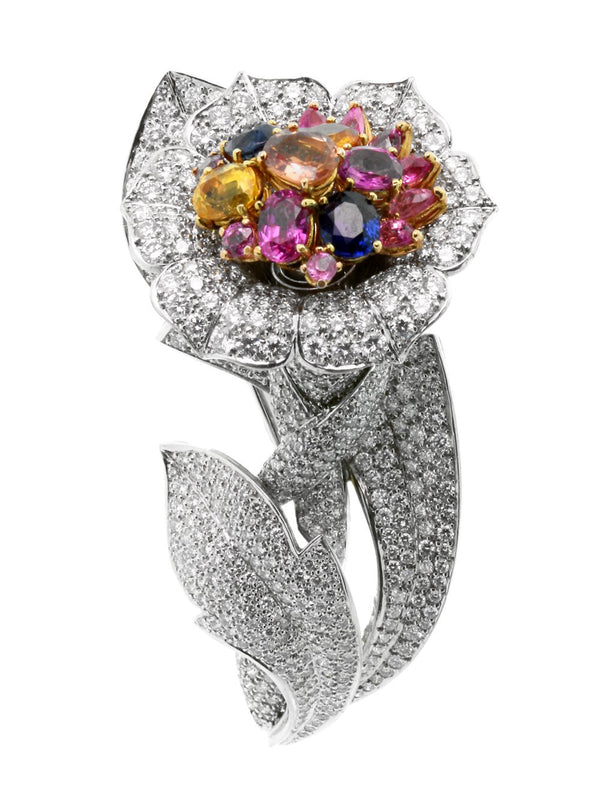

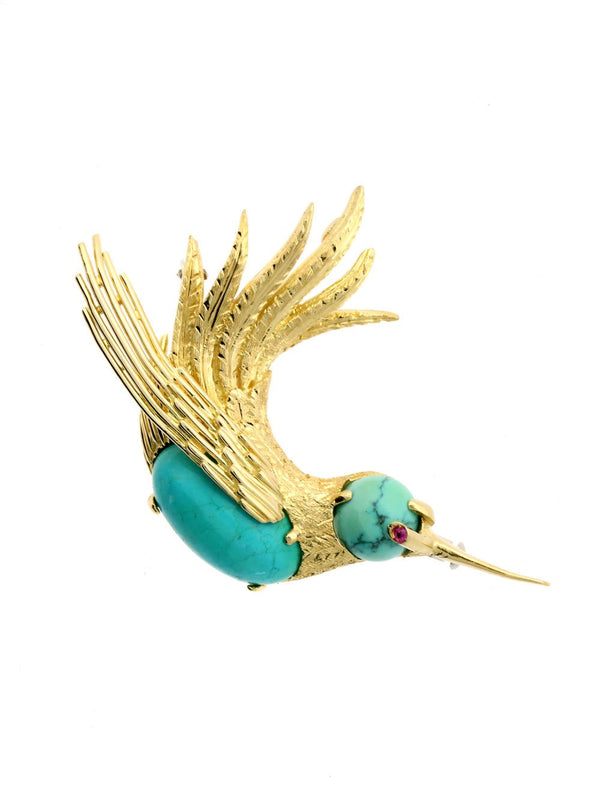
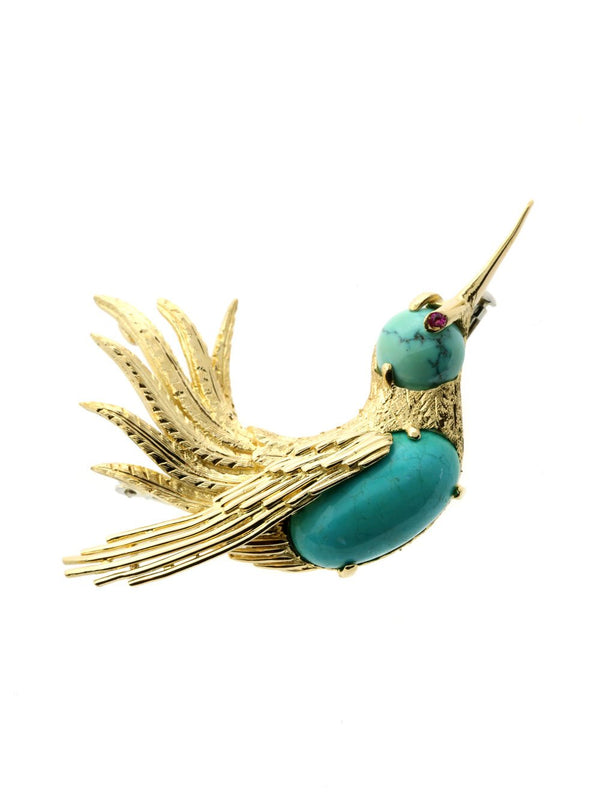
The brooch is the oldest fine jewelry format and the most misunderstood. It is also the one that has produced the greatest sculpture in the history of jewelry — and the one that offers, on the pre-owned market today, the most extraordinary quality for the price of any signed piece you can buy.
Pre-Owned Luxury Brooches
The brooch is the oldest form of jewelry humanity has produced — older than the ring, older than the necklace, predating every other format by thousands of years. It began as a purely functional object, a pin to hold fabric together at the shoulder or throat, and over millennia evolved into the format that produced some of the most technically extraordinary and artistically significant objects in the history of fine jewelry. The Cartier Panthère brooches of the Toussaint era — three-dimensional panthers in full onyx, diamond, and gold, crouching on Kashmir sapphires and Burmese rubies of extraordinary quality — are not simply jewelry. They are wearable sculpture, produced at the apex of the jeweler's craft by artists working in a medium that has never been surpassed.
And yet the brooch is the most undervalued format on the pre-owned fine jewelry market today. Its relative unfashionability in daily dressing — the shift away from formal clothing that provides the natural occasions for a brooch — has created a persistent gap between the quality of what is available and the prices at which it trades. A Cartier brooch of equivalent technical complexity and material value to a Cartier bracelet will typically sell for significantly less than the bracelet. A Van Cleef & Arpels Mystery Set flower brooch — incorporating the house's most demanding and most technically extraordinary setting technique — will trade at a fraction of what a piece of equivalent VCA craftsmanship in ring or necklace format commands. For the collector who understands this, the pre-owned brooch market is one of the most compelling opportunities in fine jewelry today.
At Opulent Jewelers, our brooch collection spans the full range of signed fine jewelry from the world's great houses — from the most wearable contemporary pieces to the most significant vintage and estate objects. Every brooch is individually authenticated before listing — signature, hallmarks, pin mechanism, stone settings, and sculptural quality all verified. All purchases are backed by our full money-back authenticity guarantee and free domestic shipping.
The Great Brooch Houses
Cartier — The Panthère and Beyond
No house has a more significant brooch heritage than Cartier — and no Cartier brooch is more significant than the Panthère. The great mid-century Panthère brooches, created under the creative direction of Jeanne Toussaint during the 1940s, 1950s, and 1960s, represent the pinnacle of the jeweler's three-dimensional sculptural art: fully articulated panthers in yellow gold, their bodies paved in brilliant diamonds with onyx spots and tsavorite eyes, crouching possessively over Kashmir sapphires, Burmese rubies, and Colombian emeralds of extraordinary quality. These pieces were created for the Duchess of Windsor, the Maharaja of Baroda, and a small number of the world's greatest collectors — and they command prices at auction that reflect their status as double collectibles: significant jewelry with their own historical story.
Beyond the Panthère, Cartier's brooch production encompasses Art Deco masterpieces of geometric precision in platinum and calibré-cut colored stones, the naturalistic floral and animal designs of the mid-century, and the contemporary brooches from the house's ongoing collections. Every period of Cartier's production is represented in brooch format and offers the collector access to the house's design history in the format that most fully demonstrates its sculptural ambitions.
Van Cleef & Arpels — Mystery Set Flowers
Van Cleef & Arpels' contribution to the brooch tradition is defined by a single technical innovation: Mystery Setting, developed by the house in 1933 and still practiced exclusively by Van Cleef & Arpels today. In Mystery Setting, gemstones — typically rubies or sapphires, though the technique has been applied to other stones — are set in a way that makes their mounting invisible: the stones sit in a continuous surface with no visible prongs, collets, or metal dividers between them, creating a seamless field of pure color that appears to float free of any setting. The technique requires extraordinary precision to execute — each stone must be calibrated to fit exactly against its neighbors, and the invisible mounting system beneath must be engineered with watchmaker-level precision. Mystery Set brooches, most often in the form of flowers, birds, and bows with ruby and sapphire petals in full bloom, represent Van Cleef & Arpels at the absolute apex of its craft. They are among the most technically demanding objects in the history of fine jewelry manufacture.
Boucheron — The Animaux de Collection
Boucheron's brooch heritage draws on the house's 165-year archive of extraordinary animal and naturalistic design. The Animaux de Collection — three-dimensional animal sculptures in 18K gold, exceptional colored stones, and diamond pavé — are the brooch format's most complete expression of Boucheron's creative ambition. Birds, cats, beetles, and mythological creatures are rendered with the technical mastery of the best goldsmiths in Paris, in pieces that begin at significant price points and represent some of the most extraordinary wearable objects produced by any house. Earlier Boucheron brooches — particularly Art Deco pieces and the great naturalistic designs of the mid-century — are among the most investment-significant pieces on the secondary market.
Chanel — The Camélia
Chanel's brooch production is defined above all by the Camélia — the camellia flower that was Coco Chanel's personal emblem and has been central to the house's design vocabulary since the 1930s. The Camélia brooch in 18K gold — its petals layered and textured with extraordinary precision, typically set with diamonds at its center — is the most recognizable Chanel brooch and one of the most wearable: a piece of sufficient authority to anchor any look without overwhelming it. Chanel also produces brooches in the Comète, Coco Crush, and various high jewelry formats, each carrying the house's characteristic combination of French refinement and conceptual directness. Chanel brooches are among the most accessible entry points to signed fine jewelry brooch collecting.
Bvlgari — Color and Gold
Bvlgari's brooch tradition reflects the house's Roman roots and its distinctive approach to precious materials — an approach that has always prioritized the sensory impact of color and the assertive presence of substantial gold over the more restrained design vocabulary of the Paris houses. Bvlgari brooches in 18K yellow gold with cabochon-cut colored stones — the large, smooth cabochons of rubies, sapphires, and emeralds that became the house's signature material — are among the most immediately recognizable and most visually striking signed brooches available on the secondary market. Mid-century Bvlgari brooches with exceptional colored stones are consistently strong performers at auction.
Harry Winston — The Diamond Standard
Harry Winston's brooch production has always centered on the extraordinary diamond — the exceptional stone set in the simplest possible mounting to maximize its brilliance and impact. The house's flower and leaf brooches, in which brilliant-cut diamonds of exceptional quality are set in platinum to create naturalistic forms of extraordinary light-gathering complexity, represent a specifically American vision of what fine jewelry should be: direct, maximally brilliant, and focused entirely on the quality of the stone rather than the complexity of the setting. Winston orchid brooches, sunflower brooches, and the extraordinary cluster designs incorporating significant fancy-color diamonds are among the most investment-significant brooch objects available on any market.
Piaget — Ultra-Thin Elegance
Piaget's brooch production draws on the house's watchmaking heritage — particularly its mastery of ultra-thin movements and its expertise in gem-setting on surfaces of extraordinary delicacy. Piaget brooches in 18K gold with diamonds and colored stones carry the same refinement and technical precision as the house's watch cases, producing pieces of considerable elegance at a scale that the brooch format uniquely enables. Piaget Rose brooches, with their precisely layered gold petals set with diamonds, are among the most feminine and most carefully crafted pieces in the contemporary fine jewelry brooch market.
Why the Brooch is the Best Value in Fine Jewelry
The Price Gap
The most significant fact about the pre-owned fine jewelry brooch market is the persistent gap between what brooches cost and what equivalent technical quality and material value cost in every other jewelry format. This gap is not a reflection of quality — the greatest brooches are technically more demanding than almost anything produced in ring or bracelet format. It is a reflection of fashion: the brooch is worn less frequently in contemporary daily life than it was fifty years ago, and prices on the secondary market have responded to that reduced demand. For the collector who is willing to embrace the format, this means access to signed fine jewelry of extraordinary quality at prices that have not yet caught up to the craft involved in making it.
The Investment Case
The great signed brooches — Cartier Panthères, Van Cleef Mystery Set flowers, Boucheron Animaux, Harry Winston diamond clusters — have generated consistent and significant appreciation at the major auction houses over the past three decades. The combination of three factors drives this: the extraordinary technical difficulty of the greatest pieces (which cannot be replicated at any cost), the rarity of significant signed examples in excellent condition (finite supply that decreases as pieces enter permanent collections), and the continued investment by the great houses in their brooch heritages (which maintains narrative and cultural value). Pieces with documented ownership history — particularly those with connections to famous collections — command additional premiums that reflect their status as historical objects as well as significant jewelry.
How to Wear a Brooch Today
The brooch's relative scarcity in contemporary dressing is itself an argument for wearing one — nothing distinguishes a look more effectively than a piece of jewelry that most people have stopped wearing. The most established placement remains the left lapel or chest: a Cartier Panthère or Van Cleef flower pinned to the lapel of a structured jacket commands the attention of a room the way no ring or bracelet can. The shoulder of a coat or blazer is the most dramatic contemporary placement — a piece worn at the shoulder is visible from across a room and gives the garment an architectural quality. A brooch also functions beautifully as a scarf pin, a bag pin, or even worn in the hair. The format is more flexible than its reputation suggests; the wearer simply needs to decide to wear it.
Authenticating a Pre-Owned Luxury Brooch
The Signature and Hallmarks
All authentic signed luxury brooches carry the house name engraved on the reverse — typically on the pin bar, the pin stem, or a dedicated flat surface on the back of the piece. The signature should be in the house's correct font and precisely formed: Cartier in its characteristic serif, Van Cleef & Arpels in its signature script with the full house name, Bvlgari in all-capitals Roman lettering, Chanel with both Cs correctly interlocked where the CC logo appears. The metal purity hallmark — Eagle's Head for 18K gold on French pieces, "750" on international pieces — and a serial number appear alongside the signature. Any fuzzy, inconsistent, or incorrectly styled engraving on the reverse of a brooch is a significant authentication concern.
The Pin Mechanism
The pin mechanism is one of the most informative craftsmanship indicators on a luxury brooch — and one of the most immediately assessable. A genuine luxury brooch has a pin stem of substantial gauge, straight and consistent from base to tip, finishing at a clean point without fragility. The catch mechanism — the spring-loaded clip that holds the pin closed — should engage with a clean, positive click and hold the pin completely without play or accidental release. The pin should hinge smoothly at its base. Any roughness in the hinge, looseness in the catch, or poorly formed pin tip is inconsistent with the manufacturing standards of the major houses and should be investigated carefully before purchase.
Stone Settings and Sculptural Quality
For three-dimensional and sculptural brooches — Panthère forms, floral and animal designs, Art Deco geometric pieces — the modeled elements and stone settings are the primary craftsmanship indicators. In genuine luxury brooches, the three-dimensional form should be precisely modeled with clean, confident lines: no softness or imprecision in the sculptural detail, no flatness in elements that should be fully rounded. Diamond pavé should be completely flush and secure — not a single stone with any movement. Colored stone cabochons should be deeply set and completely secure. Calibré-cut stones in geometric settings should fit their settings precisely with no visible gaps. At Opulent Jewelers, we assess all of these indicators as part of our authentication process for every brooch before listing.
Van Cleef Mystery Setting
For Van Cleef & Arpels Mystery Set pieces specifically, the seamless stone surface is the primary authentication indicator. In genuine Mystery Set work, the stones sit flush against each other with no visible metal between them — the surface reads as pure color with no interruption. Under magnification, the individual stones should be visible but their mounting should not. Any visible metal between stones, any unevenness in the stone surface, or any irregularity in the color field that suggests stones of significantly different quality or cut should be treated as a significant concern. Genuine Mystery Set work is one of the most immediately recognizable achievements in fine jewelry — and its imitation is essentially impossible to execute convincingly at the level of genuine Van Cleef production.
— The Opulent Jewelers Promise —
Every brooch at Opulent Jewelers is individually authenticated before listing. Signatures, hallmarks, serial numbers, pin mechanism, stone settings, and sculptural quality all verified — so you can buy with complete confidence. Free domestic shipping and a full money-back authenticity guarantee on every purchase.
Frequently Asked Questions — Luxury Brooches
Which signed brooches are the most valuable?
Cartier Panthère brooches from the Toussaint era — particularly pieces with documented provenance and exceptional colored stone centerpieces — are the most investment-significant brooches in the fine jewelry market, with major auction records reflecting decades of consistent appreciation. Van Cleef & Arpels Mystery Set flower brooches are the second most significant, combining the house's most technically demanding setting technique with some of the most elegant designs in jewelry history. Harry Winston diamond cluster and orchid brooches with exceptional stone content are consistently strong performers. Among contemporary pieces, Boucheron Animaux de Collection brooches and Chanel high jewelry brooches command strong premiums for design quality and signed provenance.
How do you wear a brooch in 2025?
The most versatile contemporary brooch placements are the left lapel of a structured jacket or blazer, the shoulder of a coat, and the center of a draped neckline. A Cartier or Van Cleef brooch pinned to the lapel of a tailored jacket is the most classic statement. On the shoulder of a coat it is the most dramatic. A Chanel Camélia used to secure a silk scarf at the neck is the most elegant. Beyond clothing, brooches work on bag straps, as hair ornaments secured with a bobby pin behind, and pinned to the crown of a hat. The format is more flexible than its reputation suggests — it simply requires the decision to wear it.
What is Van Cleef Mystery Setting?
Mystery Setting is a gemstone-setting technique invented by Van Cleef & Arpels in 1933 and still practiced exclusively by the house today. In Mystery Setting, stones — most often rubies or sapphires — are set in a way that makes the mounting completely invisible: the stones sit flush against each other with no visible metal between them, creating a seamless field of pure color. The technique requires extraordinary precision — each stone must be individually calibrated to fit exactly against its neighbors — and is one of the most technically demanding achievements in the history of fine jewelry. Mystery Set pieces represent Van Cleef & Arpels at the absolute apex of its craft.
Are brooches a good investment?
The great signed brooches from the major houses — Cartier Panthères, Van Cleef Mystery Set flowers, Harry Winston diamond clusters — have generated consistent and significant appreciation at auction over decades. The combination of technical rarity (the greatest pieces cannot be replicated at any cost), finite supply (significant signed examples in excellent condition become rarer as they enter permanent collections), and continued investment by the great houses in their brooch heritages makes the most significant pieces among the most reliable investment-grade fine jewelry objects available. For contemporary signed brooches from major houses, purchasing pre-owned at Opulent Jewelers provides genuine value versus boutique retail pricing from day one.
How do I avoid damaging my clothing when wearing a brooch?
Use care on delicate fabrics — structured wovens tolerate pins better than knits or sheers. For heavier brooches on lighter fabrics, pin through a small square of matching felt or interfacing placed behind the fabric to distribute the weight and protect the weave. Always engage the catch mechanism fully before wearing — a properly secured luxury brooch will not release accidentally. For very heavy or significant pieces, a brooch converter that distributes weight across a larger area of fabric is advisable. Never store a brooch with the pin open — close the catch before returning it to storage to prevent damage to other pieces and to the pin tip.
What is a Cartier Panthère brooch?
The Cartier Panthère brooch is the most significant object in the house's brooch production and one of the most significant jewelry objects of the twentieth century. Created primarily during the Jeanne Toussaint era — roughly the 1940s through the 1970s — the great Panthère brooches are fully articulated three-dimensional panthers in yellow gold, their bodies paved in brilliant diamonds with onyx spots and tsavorite eyes, typically crouching over a significant colored stone centerpiece — a Kashmir sapphire, a Burmese ruby, or a Colombian emerald. These pieces were produced for the world's greatest collectors and command prices at auction that reflect both their extraordinary craftsmanship and their historical significance.
How do I authenticate a luxury brooch?
Look for the house name engraved on the reverse in the correct font, the metal purity hallmark (750 for 18K gold, Eagle's Head on French pieces), and a serial number where applicable. Assess the pin mechanism — the stem should be straight and robust, the catch should engage with a clean positive click and hold without play. Stone settings should be completely secure with zero movement. Three-dimensional elements should be precisely formed with confident, clean lines. At Opulent Jewelers, every brooch is individually authenticated against all of these indicators before listing, and every purchase is backed by our money-back authenticity guarantee.
What is the difference between a brooch and a pin?
In fine jewelry usage, the terms "brooch" and "pin" are often used interchangeably, though "brooch" typically refers to larger, more substantial pieces intended as primary jewelry statements, while "pin" more often describes smaller, simpler pieces — a stick pin, a small flower pin, a name pin. In the context of signed fine jewelry from the major houses, "brooch" is the standard term for virtually all pieces, regardless of scale. The closure mechanism — the pin stem and catch — is what both formats share, and the term "pin" in the context of the mechanism refers to this functional element rather than to the piece as a whole.